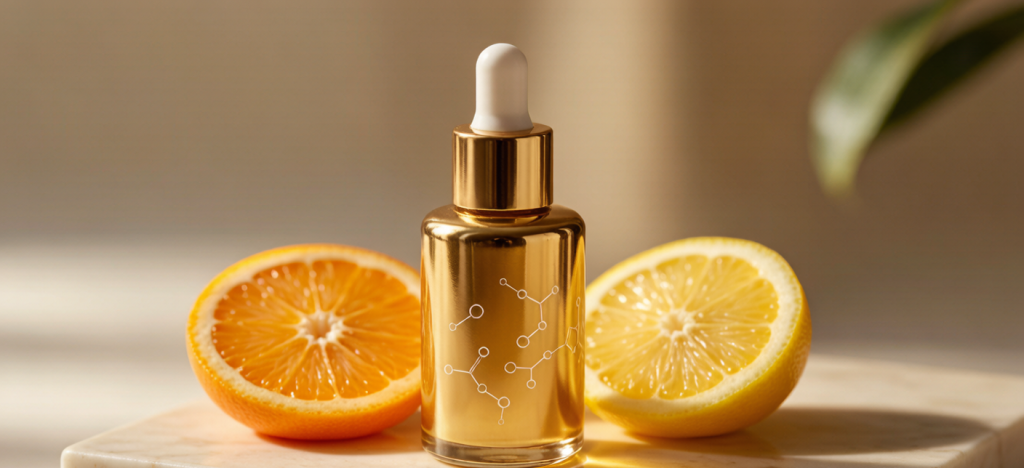
Vitamin C has dominated skincare conversations for over a decade, and for good reason. Few ingredients can match its triple threat of antioxidant protection, collagen stimulation, and brightening capacity. But not all vitamin C formulations are created equal.
Understanding the Chemistry
L-ascorbic acid (L-AA) is the pure, active form of vitamin C that your skin can directly utilize. When properly formulated at concentrations between 10% and 20% with a pH below 3.5, L-AA penetrates the stratum corneum and accumulates in the dermis, where it performs its most critical functions.
The molecule works by donating electrons to neutralize reactive oxygen species (ROS), free radicals generated by UV exposure, pollution, and normal metabolic processes. This antioxidant cascade prevents oxidative damage to cellular DNA, lipid membranes, and structural proteins.
Collagen Synthesis and Skin Brightening
Beyond antioxidant defense, L-ascorbic acid serves as an essential cofactor for prolyl and lysyl hydroxylase, enzymes responsible for stabilizing the collagen triple helix. Clinical studies demonstrate that topical application increases collagen production by fibroblasts, leading to measurable improvements in skin firmness and elasticity over 12 weeks.
The brightening mechanism operates through tyrosinase inhibition. By chelating copper ions at the enzyme active site, vitamin C suppresses melanogenesis, effectively fading post-inflammatory hyperpigmentation and sunspots without the cytotoxicity associated with hydroquinone.
Formulation Matters
The major limitation of L-AA is stability. In aqueous solutions, it oxidizes rapidly when exposed to air, light, and heat. Look for products packaged in opaque, airless containers with stabilizing agents like ferulic acid and vitamin E, which synergistically enhance antioxidant activity eightfold according to landmark research from Duke University.
Derivatives like ascorbyl glucoside, magnesium ascorbyl phosphate, and tetrahexyldecyl ascorbate offer superior stability but require enzymatic conversion to L-AA within the skin, a process with variable efficiency. The gold standard remains a well-formulated L-AA serum stored correctly and used consistently.