Copper peptides occupy an odd position in skincare. The mechanism is genuinely interesting, the laboratory data are real, and the products are frequently formulated in ways that undermine the ingredient they advertise. Understanding what the peptide does, and what destroys it, is more useful than comparing percentages on the front of a box.
What the peptide actually does
The best-studied member is GHK-Cu, a tripeptide bound to a copper ion. It was isolated from human plasma and later found in wound fluid, and it appears to act as a signal rather than as a building block. In fibroblast cultures it increases collagen synthesis, stimulates glycosaminoglycan production, and shifts the balance of matrix metalloproteinases and their inhibitors toward accumulation rather than breakdown.
Copper itself is a cofactor for lysyl oxidase, the enzyme that cross-links collagen and elastin, so the ion is not incidental cargo. Delivering copper in a peptide-bound form is thought to improve penetration and to keep the ion from generating free radicals in the wrong compartment. That last point is the reason free copper salts are not simply substituted for the peptide.
There is also a wound-healing angle. Peptide signalling of this kind is part of the early inflammatory sequence that precedes remodelling, which is why the research literature is dominated by wound and burn models rather than by cosmetic wrinkling.
Where the evidence thins out
Cell culture and animal wound models are not the same as eight weeks of use on a human face. Small human studies exist, several with methodological limits, and the measured outcomes tend to be things like skin thickness, laxity and fine line scores rather than deep wrinkle depth. Published research suggests a modest effect on photodamaged skin, with the emphasis on modest.
The honest summary is that copper peptides probably do something at the level of dermal matrix, that the effect is smaller than a retinoid produces, and that the ingredient is best understood as supportive rather than corrective. Anyone expecting retinoid-level remodelling from a blue serum will be disappointed, and the disappointment is not the ingredient’s fault.
Why the formula can defeat the active
Peptides are fragile in ways that are easy to overlook. The copper-peptide complex is stable in a narrow pH window, and strongly acidic formulas dissociate it. Ascorbic acid at the low pH it needs to be effective will both break the complex and reduce the copper, which is why the two ingredients are usually kept in separate products rather than combined in one.
Enzymes are the second problem. Proteases in fermented or enzyme-rich formulas can cleave the peptide before it reaches the skin. Chelators such as EDTA compete for the copper ion, and while they are useful for preservation, a heavily chelated formula may leave the peptide without its metal. High concentrations of anionic surfactants do similar damage, which is why copper peptides rarely appear in cleansers despite the marketing appeal.
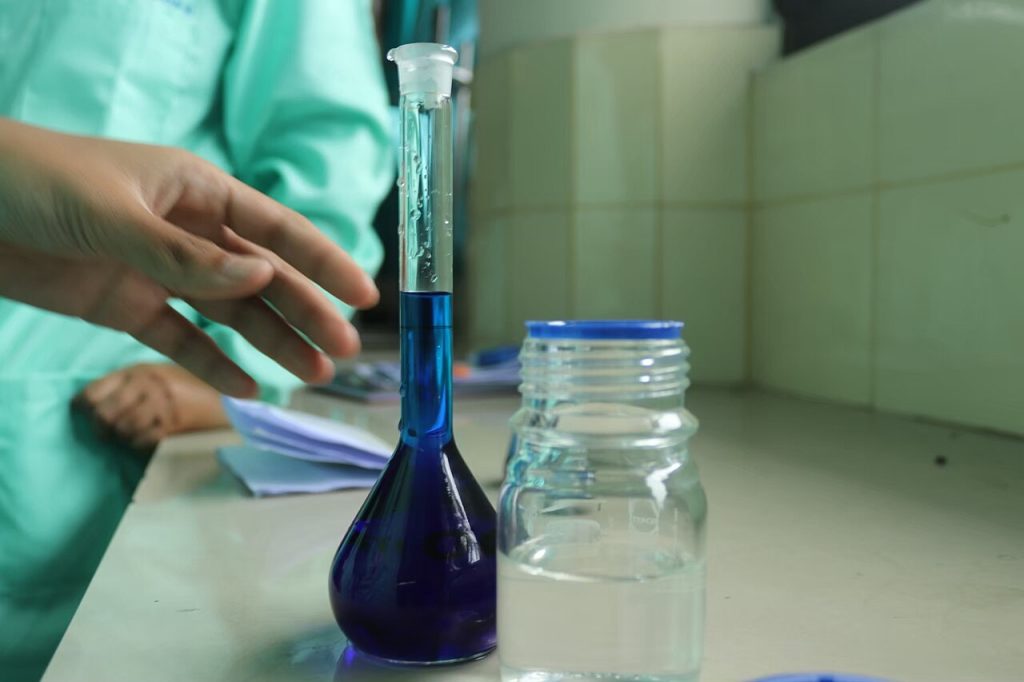
Packaging follows from this. The blue colour of GHK-Cu is a useful indicator, since a serum that has faded from blue to green or grey has lost coordination. Airless pumps and opaque glass protect it; a clear dropper bottle on a sunny shelf does not. If a product is labelled as containing copper peptides but is colourless, either the concentration is negligible or the colour has been masked.
Skin tolerance and the irritation question
Copper peptides are generally well tolerated, but they are not inert, and some people report stinging, redness or a mild breakout in the first weeks. The mechanism is not well characterised and may relate to the slight pro-oxidant activity of copper in the presence of free radicals. Anyone with active eczema, broken skin or a compromised barrier should introduce them slowly or wait.
There is a theoretical concern about combining copper peptides with high-dose antioxidants, particularly vitamin C, because copper can catalyse ascorbate oxidation. The practical version of this advice is simple: use them in different routines, not in the same layer, and do not worry about the minutes between them.
Pregnancy and breastfeeding data are limited, as they are for most cosmetic peptides. The conservative approach is to defer them, not because harm has been shown but because it has not been studied.
When copper peptides are not the right tool
If the goal is a visible change in established wrinkles, sun damage or laxity, a retinoid, a well-formulated acid routine and daily sunscreen will do more, and the peptides are a supporting act at best. If the skin is currently irritated, the priority is barrier repair rather than adding a signalling molecule. If the routine already contains three growth-factor-adjacent products, adding a fourth adds cost without adding a pathway.
This is general information, not medical advice. A lesion that is new, changing or asymmetrical is a dermatology question regardless of what is in the serum bottle, and persistent redness after starting any active should be assessed rather than worked through.